
This page contains the summary analysis and solutions of the excerpt A New Name by Linda Sue Park from the Gulmohar Class 6 English book.
A New Name By Linda Sue Park: Summary and Analysis
Introduction
“A New Name”, an excerpt from Linda Sue Park’s novel “When My Name Was Keoko”, is set against the background of post-colonial Korea under Japanese invasion. A period marked by intense social and political turmoil during which the common populace of Korea was denied the right to study their history and literature. They were stripped of their social and cultural identity as well as their name. The introduction of the “Soshi Kaimei” forced the common populace to concede their Korean roots and adopt a Japanese name and family name in place of their Korean identity.
A Silent Rebellion
‘A New Name’ follows the journey of a young ten-year-old girl, Kim Sun-hee, as she struggles to identify herself with her new name. Sun-hee narrates the historical events of the year 1940 when the Japanese government made it mandatory for the Korean populace to adopt a Japanese name in an attempt to assimilate the Korean culture. She details her father’s ingenious effort to retain their cultural identity in their new name. Anticipating serious repercussions from the government if they fail to comply with the law, the family made the tough decision to change their name.
Their family name, Kim, was changed to Kaneyama because both convey similar meanings. In Korean, ‘Kim’ translates to ‘gold’ and refers to a clan of people living in the mountains; ‘kane’ in Japanese translates to ‘gold’, while ‘yama’ refers to ‘mountains’. Therefore, Sun-hee becomes Kaneyama Keoko, and her brother becomes Kaneyama Nobou. Sun-hee considers herself especially fortunate, for her new name carries the original meaning of her name. The Japanese ‘Ko’ from her adopted name ‘Keoko’ is synonymous with her original name ‘Sun-hee’, both translating to ‘sunshine’, and she finds comfort in that familiarity. However, that sense of familiarity is not enough. She struggles to relate to her new name
Complications
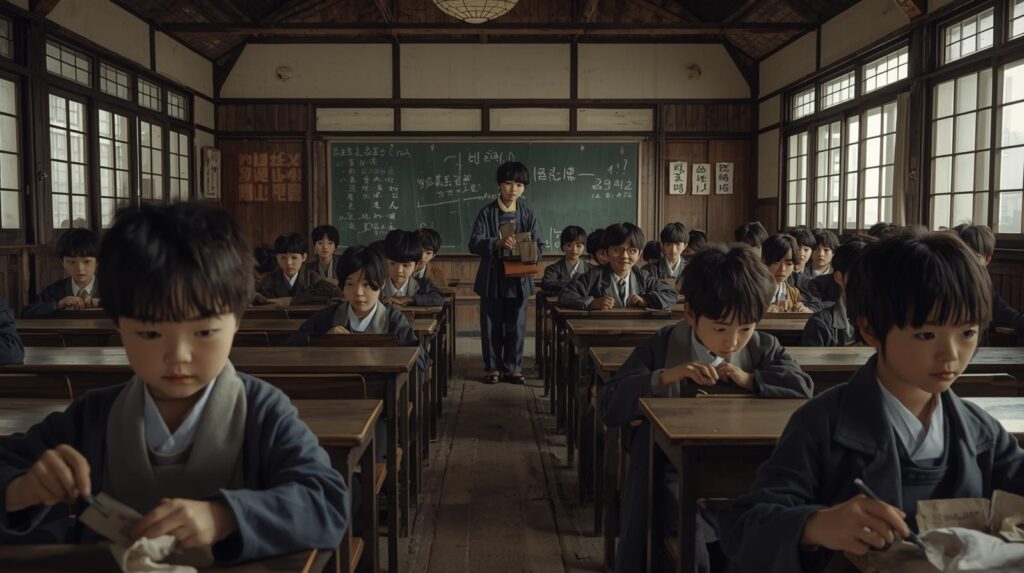
The situation worsens when, at school, Sun-hee and others are compelled to use each other’s Japanese names only. She felt obliged to follow any rules and set standards as the daughter of the vice president of the school and therefore remained vigilant in her speech. But on the second day of school, out of habit, she called one of her classmates by her original name and, as a result, got punished for it by the military attaché stationed at her school. That punishment strangely served to ignite a fire of rebellion inside her heart. She did not mind the painful welts because she wanted to remind herself of the injustice that happened to her that day.
Conclusions
Sun-hee reveals her initial admiration for the Japanese language. She was particularly fond of the word ‘tomo’ (friend) and affectionately used it to name her best friend. She even called his sisters Sachiko and Hiroko, following Japanese tradition. But bitter experience of colonial oppression turned that initial fascination into resentment. The irony emerges when, by the end, she mocks her very own Japanese name with Tomo, the very friend whose name once symbolised loyalty and affection.
A New Name by Linda Sue Park – Understanding the Text
A.1 Match the sentences in A with the correct reasons in B
A1. Sun-hee liked the names her father had chosen. He had managed to hide the meanings of the original names in their new names
2. It was very unlucky for Sun-hee that Onishi-san was present when she made the mistake. – If Onishi-san had not been there, the teacher would not have punished Sun-hee so severely
3. Sun-hee was punished despite being the vice-principal’s daughter. – Onishi-san wanted the others to get the message that no one would be spared for disobeying orders
4. Sun-hee did not want the marks to look silly. They were a reminder of the injustice that was done to her as well as to the other Koreans.
5. A mistake from Tomo would be detrimental to his reputation. As the son of the principal, he had to set an example by being more careful and correct.
B.1 Answer these questions from the story A New Name By Linda Sue Park
1. I went around whispering over and over, “Keoko. Kaneyama Keoko. Keoko. Keoko.” (para 1) from the story A New Name by Linda Sue Park.
Why did the speaker whisper the name repeatedly?
Sun-hee whispered the name ‘Keoko’ repeatedly to attune herself with her new identity and to familiarize herself with her new name.
Did she hate the new name?
She neither hated nor loved her name. She recognizes ‘Kaneyama Keoko’ as a name but cannot relate to that name. It made her feel uncomfortable.
Did she dislike all Japanese names? How do you know?
Sun-hee was fascinated by the Japanese language and was particularly fond of the word ‘tomo’ (friend). She used it to call her best friend. She called his sisters Sachiko and Hiroko because girls’ names in Japanese often ended with “ko”.
2. He made a funny sound in his throat, like “Ah!” (para 12) from the story A New Name by Linda Sue Park.
a. When did Onishi-san make this sound?
Onishi-san, the military attaché appointed at the school, made that sound when he realized Sun-hee had mistakenly called her friend by her original Korean name instead of her newly adopted Japanese name, which was strictly prohibited at the school.
b. What do you think he was feeling at that point—disappointed, worried, or almost pleased? Explain.
He was pleased to have caught the mistake because he wanted to make an example out of her punishment, which would serve as a reminder for other students to not use their original name.
3. Best of all, I was too angry to cry.
Why was the speaker angry? What reason did she have to cry? Why did she appear to feel proud of not crying? (para 17) from the story A New Name by Linda Sue Park.
Sun-hee was angry because she felt humiliated and unjustly punished by the school authority.
She was beaten with a bamboo cane in front of the classroom on the order of Onishi-san as a punishment for referring to her friend with her original name and not her Japanese name. She wanted to cry but held back in order to show strength and not weakness in front of the oppressor.
4. Read para 19. Why do you think Sun-hee wanted to stay angry?
Sun-hee wanted to stay angry to remind herself of the loss of her name and the injustice she suffered as punishment.
5. Now we were both laughing.
What caused the laughter? Were the people who were laughing doing so for the same reasons? Explain your answer. (paras 22–27)
Tomo’s tongue was getting all twisted while repeating and practicing Sun-hee’s new name, Keoko, and that’s why they started laughing. They were both laughing at the absurdity of the situation.
6. a. Why did Sun-hee tell Tomo to address her by her Japanese name?
Choose the correct answer.
i. If Tomo got confused and called her by the wrong name, then both of them could get into trouble.
ii. Tomo, being the principal’s son, could not appear to be someone who disobeyed Japanese laws.
iii. Sun-hee’s experience as a Korean child and the punishment she received made her more aware of the dangers of being caught breaking the law.
(All of them)
b. What word best describes Sun-hee for suggesting this—unhappy / wise / afraid?
Wise—because she understood the situation and wanted to protect both of them.
7. Give examples where Sun-hee understands how another person feels without their having to express it clearly in words. (paras 14, 15, and 16) —
When Onishi-san made the weird sound ‘ah,’ she could feel his excitement to serve her a bitter punishment.
The second time was when the teacher looked regretful while beating her with a bamboo cane.
The third time was when she could feel Tomo’s regretful look for having to change her name.