
List of Content: The Proposal By Anton Chekhov
- Introduction
- Summary Analysis – The Proposal
- The Proposal
- Marriage of Convenience
- The Argument
- Vanity
- Conclusion
- Previous Year / Board-Exam Questions from The Proposal
- Justify the title of the play.
Introduction
The Proposal by Anton Chekhov is a social satire. This one-act play aims to expose the superficiality of the matrimonial alliances often observed in the wealthy Russian middle-class society. These marriages are primarily based on financial consideration rather than on mutual love and trust. The drama revolves around three central characters—Stephan Stepanovitch Chubukov, a landowner; his twenty-five-year-old daughter, Natalya Stepanovna; and their neighbour, Ivan Vassililevitch Lomov.
Their families have a history of indulging in silly property disputes and ego clashes, each attempting to exert their supremacy over the other. Despite all of this conflict and rivalry, Ivan Lomov decides to propose to Natalya not out of affection or admiration for her but because of her family’s reputation and financial stability. In this one-act play, Anton employs ridiculous situations and ludicrous characters to explore the follies of the individuals and the society in general, turning a romantic gesture into a series of absurd quarrels and comic misunderstandings.
Summary Analysis – The Proposal by Anton Chekhov.
The Proposal
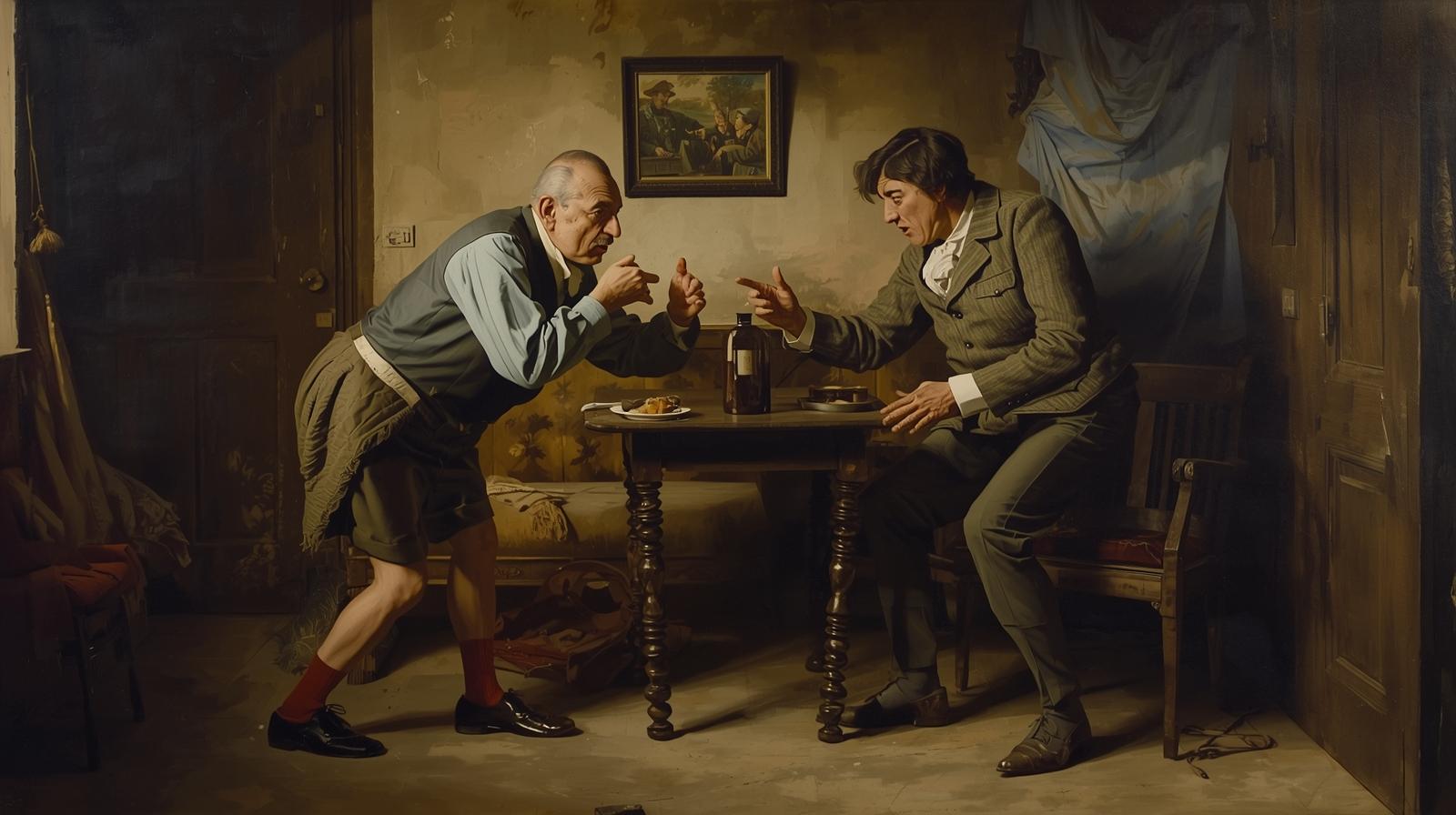
The entire drama unfolds in the drawing room of Stephan Chubukov’s country house, set in the evening time. Ivan Lomov arrived to propose marriage to Chubukov’s daughter, Natalaya. Chubukov, initially suspicious, mistakes Ivan’s visit as a plea for money; however, he becomes exceptionally happy when he hears of the marriage proposal for his daughter. He instantly promises his daughter’s consent without even consulting her. Chubukov claimed that his daughter Natalaya was already in love with him and desired him like a lovesick cat.
Marriage of Convenience (The Proposal by Anton Chekhov)
Ivan Vassilevitch Lomov is a thirty-five-year-old hypochondriac bachelor who is anxious about his marriage prospects. He was convinced that if he is too selective over potential partners and aspires for love, he might never be able to get married, yet he feels that he can no longer remain unwed. Consequently, he decides to propose to Chubukov’s daughter, Natalaya Stepanova, instead. He considers her to be an excellent housekeeper and a well-educated individual, which he believes is more than what he could possibly expect from his partner.
He regards her as a socially suitable match, especially considering her family background. Natalaya, on the other hand, is a prideful, headstrong, and quarrelsome woman. She puts an excessive amount of importance on her family assets. She enters the drawing room and casually talks to Ivan Lomov, unaware of the proposal.
The Argument
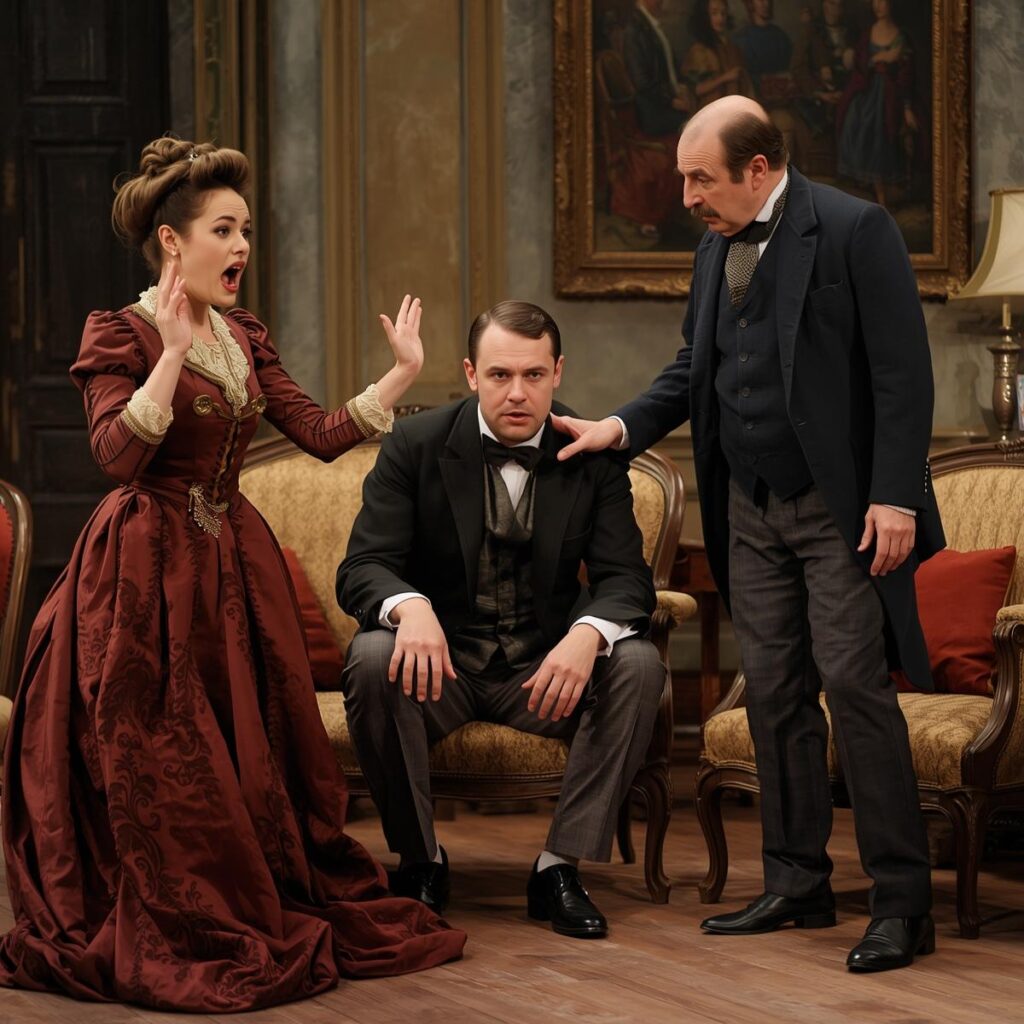
Their trivial discussion, however, quickly escalates into a heated argument over property rights to a piece of land named Oxen Meadow, deviating from the true purpose of the visit. Both Chubukov and Lomov started claiming their ownership, throwing profanities at each other, which ultimately culminated with Lomov threatening to sue them. Both father and daughter proceeded to verbally abuse him and drove him out of their house. Overwhelmed by anxiety and a nervous breakdown, Lomov staggers out of the house, fearing for his life.
Vanity
A few moments after his departure, Chubukov reveals the real purpose of Lomov’s visit to Natalya, who is now hysterical over losing an advantageous marriage prospect. It held little significance to her that the proposal came from the very man whom she had insulted and chased away from their home just a few minutes earlier; she only cared about securing a marriage. She begged her father to bring him (Ivan) back, who was equally dumbfounded by the situation. He wanted to rush after Ivan but did not want to talk to him in his wounded pride.
Conclusion
Chubukov chased after Ivan to appease his anger at his daughter’s insistence, who was distraught over the loss of a convenient marriage prospect. Chubukov succeeds in bringing him back. However, instead of reconciling and proceeding with the marriage proposal, the two started arguing again — this time over whose dog is superior. They even started ridiculing each other’s dog.
In the heat of the argument, Lomov’s condition deteriorates, and he faints on the spot. When he finally regains his consciousness, Chubukov hurries to marry his daughter off to him. But their argument over whose dog is superior does not end. The play concludes in a farcical chaos, highlighting Chekhov’s critique of a society in which marriage, pride, and materialism take precedence over human emotion and reason.
Previous Year / Board-Exam Questions from The Proposal By Anton Chekhov
- Why does Chubukov suspect Lomov when he comes to his house in the drama The Proposal by Anton Chekhov?
(Asked in CBSE 2009, 2011, 2023)
Lomov’s formal visit to his residence was initially confusing to Chubukov, as the two are neighbours and usually meet each other in casual clothes. His formal attire at first makes Chubukov wonder if there is a special event that he is attending after their meeting. Lomov’s awkward, nervous gait makes him appear even more suspicious, leading Chubukov to mistakenly assume that he has come to borrow money.
However, when Ivan reveals his intent to propose marriage to Natalaya, his initial suspicion turns into delight. In his excitement, he hastily assures his daughter’s consent without even consulting her. The purpose of wearing the formal dress was to make a charming impression while proposing marriage to his daughter.
2. Why is Chubukov surprised at Lomov’s wearing of a formal evening dress when Lomov comes to meet him in the drama The Proposal by Anton Chekhov?
Chubukov is initially perplexed at Lomov for wearing a formal evening dress while visiting him because the two are neighbours and typically meet each other in casual, normal clothes. His formal appearance immediately makes him wonder if there is a special event or occasion that Lomov is attending after their meeting. Being somewhat mistrustful and materialistic in nature, Mr Chubukov mistakenly assumes that Lomov has come to borrow money. However, when Ivan reveals his intent to propose marriage to Natalaya, his suspicions turn into a pleasant surprise because he wanted to marry his daughter off, and Lomov was a well-established, well-mannered individual, which made him a suitable match for his daughter.
3. What was Lomov’s opinion about his dog, Guess?
Ivan Lomov is exceedingly boastful over the pedigree of his dog, Guess, whom he purchased for only 125 roubles but considers worth more than the price he had paid. Natalaya, however, disagrees. She compares her dog, Squeezer, to Guess and retorts that her dog, whom she purchased for only 85 roubles, is far superior to Lomov’s Guess. Natalaya insists that Squeezer is younger than Guess and still has room for development, whereas Guess is already old and lame.
Their argument over whose dog is superior quickly escalates when Ivan dismisses Natalaya’s claim about Guess and mocks her dog, Squeezer, by calling it an overshot, with a longer upper jaw and misaligned teeth, which makes it an incapable hunter. Natalaya proudly asserts that her dog, Squeezer, is the offspring of Harness and Chisels, two well-bred dogs whose lineage rivals even the best of the hunting dogs in the neighbourhood. She ridicules Guess’s uncertain parentage, describing him as old and unattractive, like a worn-out cabby horse. Lomov counters sharply and declares that dogs of Squeezer’s kind are common and that he is not even worth paying twenty-five roubles for.
4. Justify, in brief, the title of the play The Proposal by Anton Chekhov
The entire story of the drama concerns a marriage proposal. Ivan Vassilevitch Lomov offers a marriage proposal to Chubukov’s daughter Natalaya Stepanova. However, misunderstandings and trivial conflicts transform this romantic event into a farcical nightmare. Anton Chekhov’s one-act social satire, The Proposal, offers a critique of the materialistic nature of matrimonial alliances observed in the wealthy Russian families.
Ivan Vassilevitch Lomov is a thirty-five-year-old hypochondriac bachelor who is anxious about his marriage prospects. He was convinced that if he is too selective over potential partners and aspires for love, he might never be able to get married, yet he feels that he can no longer remain unwed. Consequently, he decides to propose to Chubukov’s daughter, Natalaya Stepanova, instead.He considers her to be an excellent housekeeper and a well-educated individual, which he believes is more than what he could possibly expect from his partner. He regards her as a socially suitable match, especially considering her family background.
Chubukov hastily agrees to the proposal without consulting his daughter. Natalaya, unaware of the marriage proposal, insults and chases him out of her residence due to a trivial conflict over the ownership of Oxen Meadows.However, when her father reveals the purpose of Ivan’s visit a moment later, she acts hysterical over the loss of the proposal.
When he returns a second time, instead of reconciling, they start arguing over whose dog is superior. The drama concludes with the newly married couple continuing to argue over the supremacy of their dog.
Hence, the title “The Proposal” is most appropriate, as it is the central event, and the entire plot is built around Ivan’s attempt to propose and the chaos that follows. The marriage proposal serves to expose the hypocrisy of the wealthy society that often degrades the sanctity of marital alliances to mere financial convenience.