The second half of A-Z collective nouns.
3. Objects and Things (collective Nouns)
General Objects
| 1. A bunch of keys 2. A stack of books 3. A pile of clothes 4. A heap of stones 5. A set of tools 6. A suite of rooms 7. A fleet of ships 8. A fleet of cars 9. A fleet of buses 10. A string of pearls 11. A packet of letters 12. A sheaf of papers 13. A quiver of arrows 14. A bundle of sticks 15. A cluster of buildings 16. A set of buildings 17. A block of buildings |
4. Nature, Geography, Elements
| 1. A system of rivers—a set of structured rivers that fall into one another. 2. A chain of rivers—rivers linked in sequence 3. A network of rivers—when many rivers connect and branch out. 4. A confluence of rivers –when two or more rivers join together. 5. A series of rivers—rivers arranged one after another. 6. Basin – all rivers draining into one main river. A chain of islands 7. A forest of trees—a large area covered mainly by trees. 8. A grove of trees—a small group of trees of the same kind growing together. 9. A clump of bushes—a small, tight group of bushes growing together. 10. A thicket of trees—a dense, tangled group of trees and shrubs growing together. 11. A wood/woodland—a large area with many trees, smaller than a forest. 12. A cluster of leaves—a group of leaves. 13. A chain of islands—a series of islands arranged in a group. |
| 1. A range of mountains – a long line of mountains that are connected together, e.g., the Himalayas are a mountain range. 2. A chain of mountains – a line of mountains linked together like a chain, e.g., a chain of mountains separates two countries. 3. Mountain chain – a line of connected peaks 4. A group of mountains – several mountains close to each other. 5. A ridge of mountains – a long, narrow, elevated line of mountains or hills, e.g., we could see a dark ridge of mountains against the evening sky. 6. A massif – a compact block of connected mountains formed as a single unit, e.g., the Alps form a mountain massif. 7. A field of crops – a large field where crops are grown 8. A bed of flowers – a piece of land specially prepared for planting flowers 9. A hedge of shrubs – a row of closely planted shrubs. |
5. Abstract Concepts & Creative Works
- An anthology of poems – a curated book containing poems by one or multiple poets, e.g., the university published an anthology of poems written by their students.
- A series of books – is a number of books connected by a storyline, themes or characters, e.g., the Good Girl’s Guide to Murder is a famous series of books that has been made into movies.
- A collection of stories – refers to a book containing a number of short stories, e.g., Sarat Samagra is a collection of stories by Sarat Chandra Chattopadhyay.
- A body of work – the total achievement of an artist, writer or professional, e.g., Rabindranath Tagore’s body of work includes thousands of poems, dramas, songs, etc.
- A medley of tunes – a combination of several music pieces performed one after another or blended, e.g., the orchestra performed a medley of tunes from classic films.
- A repertoire of songs – all the songs a singer or musician is prepared to play, e.g., the band has added three new songs to their repertoire of songs.
- A catalogue of errors – a long list of mistakes, often repeated, e.g., the reporter has exposed a catalogue of errors in the company’s account.
- A string of excuses – many excuses, e.g., he came up with a string of excuses for coming late to the office.
- A troupe of ideas (figurative) – a lively, creative group of ideas, e.g., She always comes up with a troupe of ideas.
6. Scientific / Technical Collective Nouns
- A culture of bacteria
- A chain of molecules
- A field of study
- A dataset of entries
7. Modern/Technology-Related Collective Nouns
(Not classical but widely used)
- A network of computers
- A cluster of servers
- A fleet of drones
- A stream of data
- A cloud of information
8. Rare, Poetic, or Humorous Collective Nouns
- A murmuration of starlings – thousands of starlings flying together in a swirling formation, e.g., we watched a murmuration of starlings flying over the mountains.
- A flamboyance of flamingos — refers to the bright, vibrant formation of flamingos standing together, e.g., a flamboyance of flamingos stood at the edge of the lake.
- A business of ferrets – a general term attributed to a group of ferrets due to their curious, busy nature, e.g., a business of ferrets hid behind the bushes.
- A skulk of foxes – a general term attributed to a group of foxes due to their stealthy nature, e.g., a skulk of foxes are hunting in the forest.
- A slither of snakes – a general term used to refer to a group of snakes for their slithering movement, e.g., a slither of snakes moved across the river.
- A huddle of walruses – a group of walruses huddled together for warmth, e.g., a huddle of walruses are nesting on the ice.
- A mischief of mice — refers to a group of trouble-making mice, e.g., as we entered the hallway, a mischief of mice ran through the ground floor.
- A parcel of rogues – a group of dishonest, mischievous people, e.g., a parcel of rogues was taken into custody by local police last Sunday.
- A blessing of unicorns – a mythical creature of a fantasy world, e.g., a blessing of unicorns galloped across the enchanted valley.
- ‘A whisper of gossip– refers to soft, hushed conversation, e.g., a whisper of gossip spread through the community.
- A tangle of cables – cords and wires tangled together, e.g., the thief fell tripping over a tangle of cables behind the TV counter.
Collective Nouns in Food
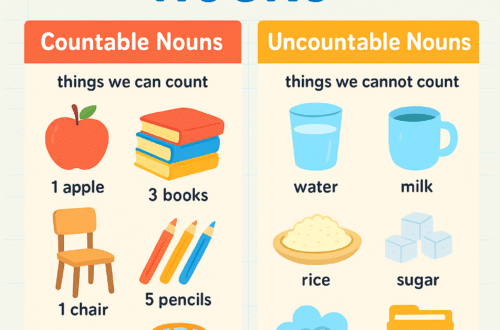
Collective nouns are sometimes used to show a piece, portion, specific amount, or unit of something that cannot be counted directly.
Foods like rice, cake, bread, flour, honey, and ice cream are uncountable. We use collective nouns to count them.
| Sweets & Desserts | Grains & Staples |
|---|---|
| 1. A slice of cake 2. A tub of ice cream 3. A cone of popcorn 4. A jar of honey 5. A bottle of syrup | A bowl of rice A cup of flour A loaf of bread A slice of bread A packet of wheat/flour A bushel of corn/wheat |
| Greens |
|---|
| 1. A bunch of spring onions 2. A bunch of coriander 3. A crate of vegetables 4. A basket of vegetables 5. A sack/bag of vegetables |
If the group is acting like one unit, a singular verb is used, but if the individuals in the group are acting separately, a plural verb is used.
| Fruits & Vegetables |
|---|
| A basket of fruit A bunch of grapes A bunch of bananas A cluster of berries A basket of mangoes A bag of apple A sack of potatoes A head of cauliflower/cabbage A bulb of garlic A pod of peas |
| Liquids & Drinks |
|---|
| 1. A bottle of milk/juice 2. A glass of water 3. A cup of tea/coffee 4. A jug of lemonade 5. A carton of milk |
- A sack of vegetables – A large bag filled with vegetables. Example – Sellers take a sack of vegetables to the restaurant every day.
- A bunch of spinach/coriander/spring onions – a bunch of leafy greens tied together. Example – She bought a bunch of spinach from the supermarket.
- A crate of vegetables – vegetables packed together in a wooden or plastic crate. Example- Buyers are haggling over a crate of vegetables near the railway station
When it comes to cooked foods, especially some of our favourites, there is a plethora of countable nouns to choose from to delineate these food items individually and as dishes. Many cooked foods can be countable or uncountable depending on their usage in the sentence.
Take noodles, for example; on the basis of the containers in which the dish is either kept unprepared or served, we use a bowl, packet, plate, or even a cup of noodles. It is countable only when we talk about different kinds of noodles and individual strands/pieces.
For example—
I picked up two noodles with my chopstick.
In the previous example we referred to noodles as individual pieces.
‘Noodles’ is generally uncountable when we refer to it as a dish. Because it cannot be counted individually in normal use, we use container words to measure it. For example—
I ate some noodles.
They placed a hot serving of noodles in front of me.
I bought a bundle of noodles from the grocers.
Similarly, pasta and spaghetti, when referred to as general dishes, are both uncountable but countable as individual pieces/strands. Here are some examples.
1. I took a forkful of spaghetti. (uncountable)
2. The restaurant is famous for their serving of spaghetti. (uncountable)
3. A strand of spaghetti fell on the floor. (countable)
| Prepared Foods |
|---|
| 1. A plate of noodles 2. A bowl of soup 3. A pot of curry 4. A dish of pasta 5. A stack of pancakes 6. A platter of sandwiches |
| Meat, Fish & Protein |
|---|
| 1. A fillet of fish 2. A slice of ham 3. A rack of ribs 4. A joint of meat 5. A slab of meat 6. A strip of meat 7. A bucket of chicken |
Collective Nouns For Stars & Other Heavenly Bodies
A system of planets – a group of planets revolving around one star.
A solar system – a star and all the planets orbiting it.
A constellation – a group of stars forming a recognisable pattern. e.g., Pleiades, Orion, etc.
A galaxy – a massive system of billions of stars, planets and dust, e.g., the Milky Way galaxy.
A cluster of galaxies – multiple galaxies grouped together by gravity, e.g., – the Virgo cluster, Coma cluster, etc.
A nebula of stars – a cloud of gas and dust where stars are born, e.g., the Orion nebula.
A swarm of stars –a group of stars appearing like they are packed and moving together.
| Stars |
|---|
| 1. A system of planets 2. A solar system 3. A constellation (group of related stars) 4. A galaxy (collection of billions of stars) 5. A cluster of galaxies 6. An orbit of satellites 7. A belt of asteroids (e.g., asteroid belt) 8. A ring of planets/moon (e.g., Saturn’s rings) 9. A cloud of comets (e.g., the Oort cloud) 10. A swarm of meteoroids |
| 1. A galaxy of stars 2. A field of stars 3. A host of stars 4. A swarm of stars 5. A nebula of stars 6. A cluster of stars 7. A constellation of stars |
An orbit of satellites—several artificial satellites around a planet, e.g., Bhaskar I and II
A belt of asteroids—asteroids forming a round pattern in between two planets, e.g., asteroids between Mars and Jupiter.
A ring of planets/moons—heavenly bodies arranged in a circular pattern around a planet, e.g., Saturn’s rings.
A cloud of comets—a giant cloud-like region containing frozen bodies, e.g., the Oort cloud.
A swarm of meteoroids—many small rocks travelling together in space
Here are some example sentences:
- We saw a cluster of stars through the telescope last night.
- The scientists have discovered a system of planets around a star nearly two thousand light-years away.
- The Oort cloud is a cloud of comets surrounding our solar system.
- The meteor shower surprised the crowd as a swarm of asteroids entered the earth’s atmosphere.
- There is a constellation of satellites orbiting the earth sending signals.