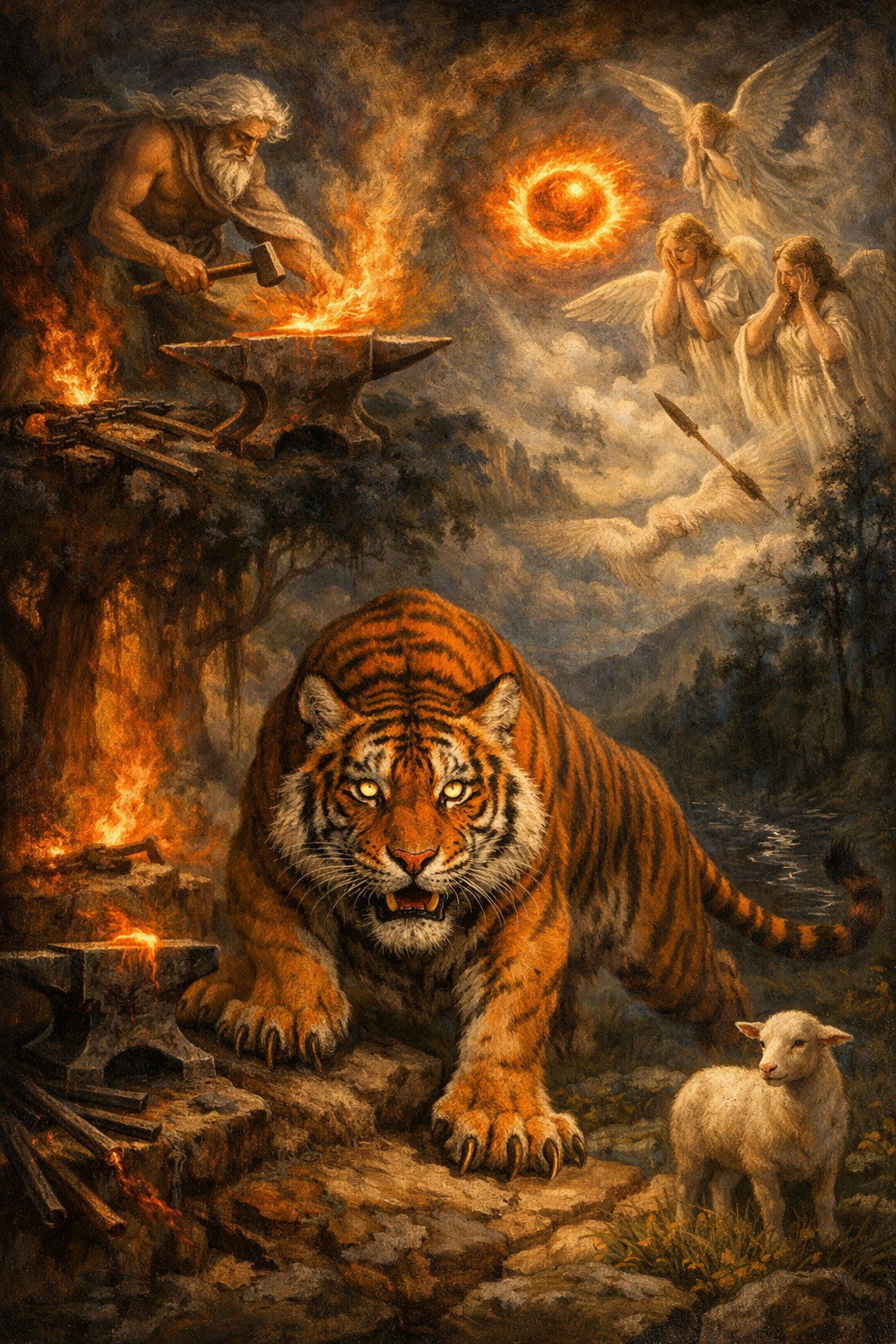
“The Tyger” is a representative poem taken from William Blake’s “Songs of Experience”, published during the climax of the French Revolution in 1794. Blake’s Tiger is symbolic of the uninhibited natural energy existing within man, equipped to overcome the difficult experiences of life.
Tyger! Tyger!
burning bright
In the forests of the night,
What immortal hand or eye
Could frame thy fearful symmetry?

In what distant deeps or skies
Burnt the fire of thine eyes?
On what wings dare he aspire?
What the hand dare seize the fire?

And what shoulder, and what art,
Could twist the sinews of thy heart?
And when thy heart began to beat,
What dread hand? and what dread feet?

What the hammer? what the chain?
In what furnace was thy brain?
What the anvil? what dread grasp
Dare its deadly terrors clasp?

When the stars threw down their spears,
And water’d heaven with their tears,
Did he smile his work to see?
Did he who made the lamb make thee?

Tyger! Tyger!
burning bright
In the forests of the night,
What immortal hand or eye,
Dare frame thy fearful symmetry?
Substance ( The Tyger)
The tiger is a majestic creation. In the forest at night, its eyes burn like golden balls of fire. The poet wonders who could have created such a magnificent creature. Who could have forged its graceful, well-proportioned, feline form? He wonders at the extent to which the creator has gone, imagining what wings he might have possessed to plunge into the volcanic depths or soar to the distant skies to obtain the fire of its burning eye.
He marvels at the wondrous strength required and the immense time spent creating the ferocious muscles of the beast’s heart. And when the tiger finally comes alive, he dreads the horrible strength of its vicious claws and paws. He questions what hammer, chains and anvil he employed to forge the awe-inspiring symmetry of the tiger. The poet wonders in what furnace the tiger’s brain was forged and contemplates the terrible strength of its mighty creator, capable of grasping its dreadful brain.
Even the angels were so overwhelmed by the tiger’s beauty that they threw down their spears and cried for mercy. The poet could not comprehend how mighty God, who created the innocent lamb, could dare create a terrible beast as ferocious and unindomitable as the tiger. He ultimately wonders if God felt content and smiled with satisfaction upon witnessing his own unimaginable creation.
The poem conveys a profound meaning of life. It contemplates two essential elements in life: innocence and experience. When innocence is destroyed by tragic experience, wrath is required to overcome the confines of fear and repression created by the traumas of those said vicious experiences. The tiger symbolises the fierce fire inside human souls. It is a spiritual essence capable of burning away ignorance, repression and superstitions birthed by social injustices that seek to take advantage of the innocent and underprivileged.
Blake describes the process of the tiger’s creation through a series of wonderstruck questions. But what he describes are not actual events as observed and understood by man but rather spiritual events that must be stated through symbols to make them intelligible.
The course of life presents unavoidable circumstances from which it is impossible to come out unscathed both physically and spiritually. Tragic experiences traumatise the innocent, instilling debased and perverted desires. They paralyse with fear, imprisoning the mind, rendering man blind to possibilities and creativity. Fear or denial of life breeds hypocrisy. Thus, when innocence is destroyed, God creates the tiger. It is a spiritual revolt, an awakening to release man from the prison of greed, pride and repression.
The creation of a tiger is a necessity to restore the mind to innocence. Upon witnessing its terrifying beauty, the forces of darkness retreat in trepidation, restoring peace and goodness. And God smiles on the triumph of innocence over experience.
Blake’s “The Tyger” is a lyrical masterpiece composed in monosyllabic diction and trochaic rhythm. Alliteration is effectively used to emphasise the poem’s metrical structure.
Annonations:
‘Tyger’ symbolises the uninhibited natural energy that exists within man, necessary to break the constraints of experience.
According to Blake, man passes from innocence to experience. While innocence is symbolised by the lamb, and experience is symbolised by the tiger. When innocence is destroyed by experience, the tiger appears as a spiritual revolution to liberate the mind from repression and superstition and restore balance.
‘Burning bright’ refers to the two burning eyes of the tiger, visible from the midst of the dark forest of night.
The forest of night symbolises a dark, depraved world filled with ignorance, repression and superstition. Some believe that the forest of night, where the tiger lurks, refers to sterile errors (dead trees) that conceal the path to light.
In this line, ‘eye’ refers to the concept of the tiger as envisioned by its creator even before the tiger’s existence. The poet wonders about the skilful hands of the creator who could have forged such a terrifying beast. The use of wonderous questions creates a sense of reverence for the mighty creator.
“Could frame thy fearful symmetry”—In this line, the poet emphasises the awe-inspiring power of the creator, capable of framing the terrifying yet majestic feline form of the tiger.
“In what distant deeps or skies/Burnt the fire of thine eyes.”
“Distant deep” refers to volcanic depths. Blake wonders at the volcanic depths or skies the great creator had reached to obtain the fire of the tiger’s eyes, visible from the deep forest of night.
“On what wings dare he aspire? “What hand dare seize the fire?”
Here is a reference to Prometheus stealing fire from the hearth of Zeus for mankind. The poet wonders what kind of wings the creator had worn to soar to heaven and bring the fire with him to forge the tiger’s eye. He wonders what mighty hand could hold the fire.